Choose a 12V LiFePO4-Batterie by calculating the energy your equipment needs, shortlisting a capacity, and checking the proposed model against load current, charging and installation requirements. MYLION offers 7Ah, 12Ah, 24Ah, 30Ah, 50Ah, 100Ah and 250Ah options. The right choice is the one that completes the required working or backup period within your system constraints.
For OEM teams, system integrators and project buyers, a useful comparison connects each capacity with a practical decision: how much energy is needed, what reserve is justified, and whether the selected battery can be integrated into the equipment. This guide follows that selection process across the MYLION range.
Compare MYLION 12V LiFePO4 batteries from 7Ah to 250Ah
MYLION’s 12V LiFePO4 battery series provides seven capacity directions. The linked product pages list a nominal voltage of 12.8V. “12V” describes the system class; check the device’s complete input-voltage range and any required regulation before selecting a battery.
Nominal energy is calculated as 12.8V × Ah for consistent comparison; it is not usable delivered energy or a runtime guarantee.
These are starting points for comparison, rather than fixed application assignments. A CCTV installation, for example, may need a compact battery for one essential branch or a much larger battery for several loads and a longer outage. The load and duration determine the energy requirement.
Which capacity range should you shortlist?
7Ah and 12Ah: start with the essential load
Consider 7Ah and 12Ah when the measured energy requirement is relatively small, such as a limited backup task or a portable device with a defined recharge opportunity. Begin by identifying exactly which functions must continue and for how long.
At the same nominal voltage, 12Ah provides about 71% more nominal energy than 7Ah. That makes it worth comparing when 7Ah leaves insufficient reserve. The increase does not establish the finished device’s runtime: converter losses, operating conditions and shutdown limits still matter.
Ask MYLION to review the shortlisted model with the available compartment, terminal access and connection arrangement. A battery that satisfies an energy calculation also needs room for installation, insulation and servicing.
24Ah and 30Ah: compare the margin around your target
The 24Ah and 30Ah options are useful intermediate candidates when a smaller energy budget falls short. They allow a buyer to discuss additional autonomy without immediately moving to 50Ah.
Moving from 24Ah to 30Ah adds 25% nominal energy. That can provide room for a longer operating period or an agreed reserve, provided the chosen model meets the other requirements. In the worked example below, 24Ah clears the illustrative energy calculation; 30Ah offers a larger energy allowance.
Compare the actual models before deciding. Amp-hours describe capacity, while discharge capability is a separate specification. A 30Ah label alone does not prove a higher current rating, an identical case or interchangeability with a 24Ah battery.
50Ah: evaluate a larger energy budget
A 12V 50Ah LiFePO4 battery has 640Wh of calculated nominal energy at 12.8V. Shortlist this option when the load-and-duration calculation exceeds the intermediate capacities or when the project needs a justified additional reserve.
For a security or monitoring project, include every device expected to run from the battery: cameras, communications equipment, controllers and conversion electronics. Use the actual operating sequence, including functions that activate only at certain times. Then compare the 50Ah option with the enclosure, charging source and maintenance arrangements.
100Ah and 250Ah: plan autonomy and recovery together
The 100Ah and 250Ah options provide 1,280Wh and 3,200Wh of calculated nominal energy respectively. At the same voltage, 250Ah has 2.5 times the nominal energy of 100Ah. These capacities deserve consideration when a project has a substantial backup or operating-energy requirement.
Include recovery in the decision. After an outage, the charging system must replenish the used energy within the required readiness window. A larger battery will not necessarily recharge quickly through an existing limited charging source.
Review handling, retention, cabinet space and access alongside capacity. If the calculation points toward 250Ah, discuss the installation as a complete assembly with MYLION before committing to a sample.
How do load and runtime determine battery capacity?
Work in watt-hours when comparing several loads. Record average power at the equipment input over the required operating sequence. If your measurement is already taken at the battery, avoid counting the same conversion loss twice.
Required load energy (Wh) = average load (W) × operating time (h).
For an initial nominal-capacity estimate, divide the load energy by the assumed usable-energy fraction, conversion efficiency and nominal battery voltage. Apply a reserve chosen for the project. The assumptions must be identified so another engineer can review the result.
For example, assume a constant 20W load for 8 hours, an 80% usable-energy fraction, 90% conversion efficiency and a 25% additional reserve:
Load energy = 20W × 8h = 160Wh.
Estimated capacity = (160Wh × 1.25) ÷ (12.8V × 0.8 × 0.9) ≈ 21.7Ah.
The next available capacity in this range is 24Ah, making it an energy-based candidate for review. Compare 30Ah if the project needs more allowance. The 80%, 90% and 25% figures are illustrative design assumptions, not MYLION performance specifications or universal sizing rules.
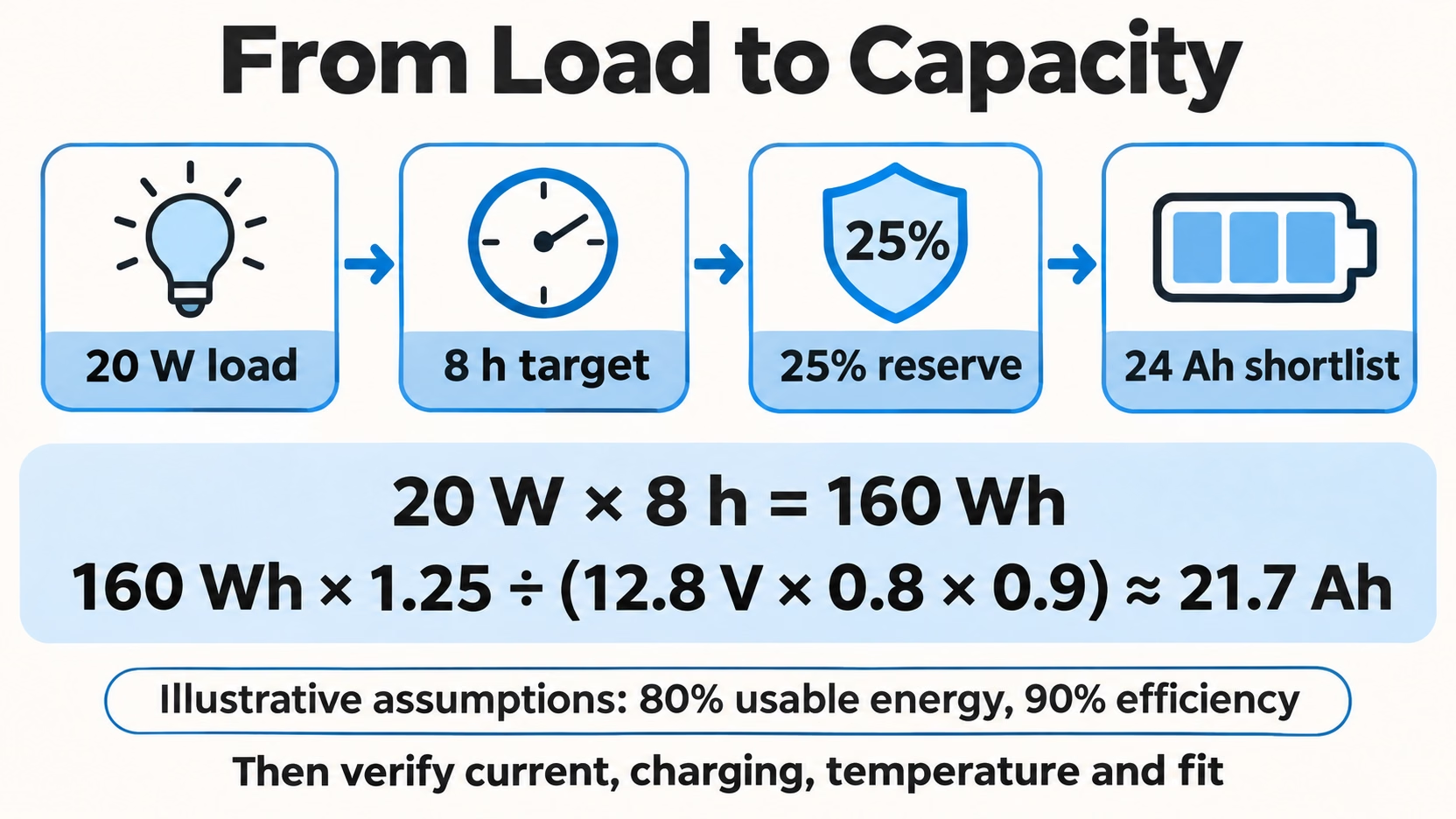 Illustrative energy sizing only: the selected model still needs current, charging, temperature and fit checks.
| Illustrative load and duration |
Calculated capacity requirement |
Next capacity to review |
| 20W for 8 hours |
21.7Ah |
24Ah |
| 50W for 12 hours |
81.4Ah |
100 Ah |
| 50W for 24 hours |
162.8Ah |
250 Ah |
All rows use the same example assumptions above. They are capacity-shortlisting calculations, not measured battery runtimes.
Before approval, replace assumptions with the agreed operating conditions, conversion data and reserve requirements. Evaluate battery aging, temperature, endpoint voltage and the required duty cycle. Confirm the resulting model in the actual device.
What should you check after shortlisting a capacity?
Use the following screen to turn an energy shortlist into a product-selection decision. Resolve each item for the proposed battery and the equipment configuration.
| Selection check |
What to confirm |
| Load current |
Continuous demand, peak magnitude, duration and repetition against the specific model’s discharge limits. |
| Ladegerätkompatibilität |
The battery’s charging requirements, the charger profile and current, and any host charging or sensing interfaces. |
| Installed fit |
The current drawing, tolerances, terminals, cable routing, mounting and access within the intended enclosure. |
| Temperature and environment |
Charging, discharging and storage conditions separately, plus the protection required by the installation. |
| Connections and system voltage |
Polarity, mating parts, full device input range and any required voltage conversion. |
Agree the model and configuration before using a sample to approve the installation.
Charger selection involves series-cell count, input range, charge current and system power management, as described in MPS’s battery charger fundamentals. Give MYLION the existing charger and host information when retaining an established design.
For solar-powered equipment, battery capacity is only one part of autonomy. Review the available charging energy and recovery after poor sunlight. For a lead-acid replacement, review charger behavior, electrical limits and installed fit before treating the proposed battery as compatible.
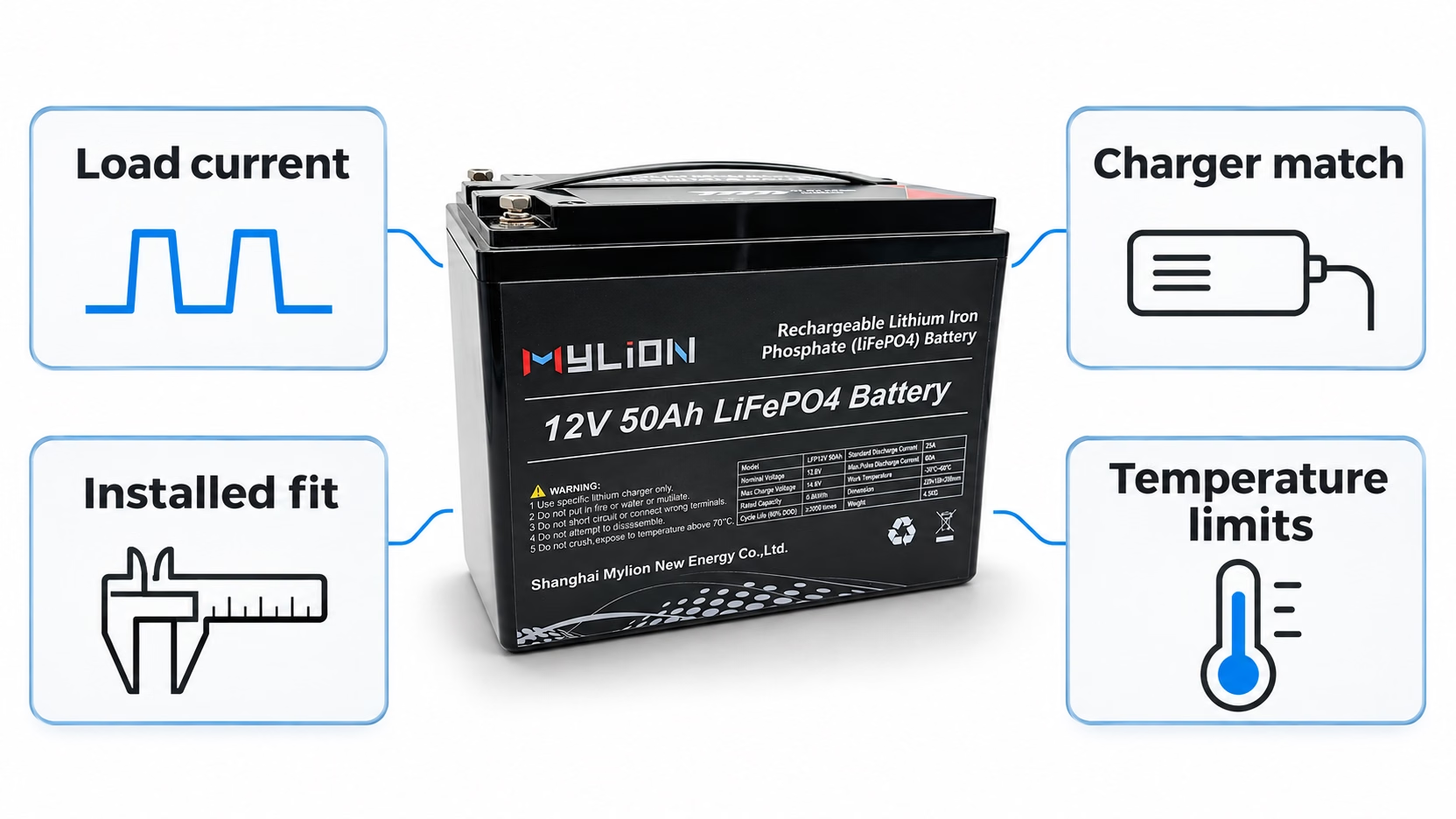 Product-based illustration of four checks to complete after shortlisting a capacity.
How does MYLION support your battery selection?
Start with the closest MYLION capacity option, then connect it to the integration requirements. If a 24Ah or 50Ah option meets the energy target but the connector, cable route or installation space needs attention, include those constraints in the same discussion.
MYLION’s battery project support includes reviewing protection, connectors, wiring, housing and charger matching according to project requirements. Its 12V product pages also describe capacity, connector, cable, housing and labeling customization support. The proposed configuration and available options should be confirmed for your project.
For a focused model recommendation, send:
- Application, device voltage range and measured load profile, including relevant peaks.
- Required operating or backup time, charging opportunities and intended environment.
- Compartment drawing, mounting constraints, connector or terminal requirements and charger details.
- Beispielziel, geplante Mengen und Zielmarkt.
Ask for a recommended model, the applicable specification and drawing, and the items that need device testing. This turns a broad request for a “12V lithium battery” into a reviewable proposal. The 12V backup battery guide provides additional background on the wider backup-system considerations.
Häufig gestellte Fragen
Should I choose a 7Ah or 12Ah LiFePO4 battery?
Compare the energy needed for the required task with both capacities. At 12.8V, calculated nominal energy is 89.6Wh for 7Ah and 153.6Wh for 12Ah. Choose after checking current, charging and installation requirements as well as the energy margin.
Is a 30Ah battery always a better choice than 24Ah?
A 30Ah option provides 25% more nominal energy at the same voltage. Whether it is better depends on the required duration, reserve, current capability and installed configuration. Capacity alone does not establish compatibility.
Does higher Ah also mean a higher discharge-current rating?
No. Capacity and current capability are different specifications. Compare the particular model’s continuous and peak-current conditions with the device load, rather than deriving an amp rating from its Ah label.
Can MYLION help when a standard option does not fit?
MYLION can review the device requirements and evaluate project-specific capacity, connections, wiring, housing and charging arrangements. Send the drawing and operating details so the team can assess a suitable direction.
Request a MYLION 12V LiFePO4 battery recommendation with your load, runtime and installation requirements to compare the most suitable 7Ah–250Ah options for your project.
 Deutsch
 English
 Español
 Français
 Italiano