A Solar Power Kit for CCTV combines solar charging, battery storage and DC power output to support cameras at sites without convenient mains electricity. It can provide an ongoing power supply by replenishing stored energy each day, provided the solar input, battery reserve and connected equipment are properly matched.
For security system integrators, equipment brands and project buyers, this offers a practical way to support remote surveillance. A coordinated kit brings the main power components together and provides a starting point for installations at farm entrances, construction sites and other outdoor locations.
This guide explains the features that make a solar power kit useful for CCTV, how it supports operation beyond daylight, and what MYLION can review for your project.
Why Remote CCTV Needs an Ongoing Power Supply
A remote camera needs power whenever monitoring is required, including after the site team has left. A gate may need observation overnight, while a temporary work area may need surveillance before permanent electrical infrastructure is available.
A rechargeable battery provides stored energy, but that energy eventually needs replacing. Adding solar charging gives the installation a local source of replenishment. With a suitable system and sufficient sunlight, the battery can recharge at the installation rather than relying on regular removal for manual charging.
This makes a solar CCTV power system worth considering where extending mains power would involve difficult cable routes or substantial installation work. It also gives buyers a way to evaluate power separately from their choice of camera and communications equipment.
How a Solar Power Kit Supports Long-Term CCTV Operation
The basic operating cycle is straightforward: collect solar energy in daylight, store energy in the battery, and use the stored energy when sunlight is unavailable or insufficient. Repeating this cycle is what allows a correctly matched system to support an ongoing monitoring requirement.
| Part of the kit |
What it does |
Why it matters for CCTV |
| Panel solar |
Collects energy from sunlight |
Provides a local charging source at the monitoring site |
| Batería recargable |
Stores energy for later use |
Supports cameras after dark and during limited solar generation |
| controlador de carga |
Manages solar charging |
Coordinates charging between the panel and battery |
| DC output and cables |
Connect the power unit to compatible equipment |
Provide the power connection for the selected camera setup |
| Mounting components |
Support installation of the assembly |
Help bring the main power components together at the site |
The important benefit is the combination. Solar charging provides replenishment, while battery storage makes that energy available beyond the hours of strong sunlight.
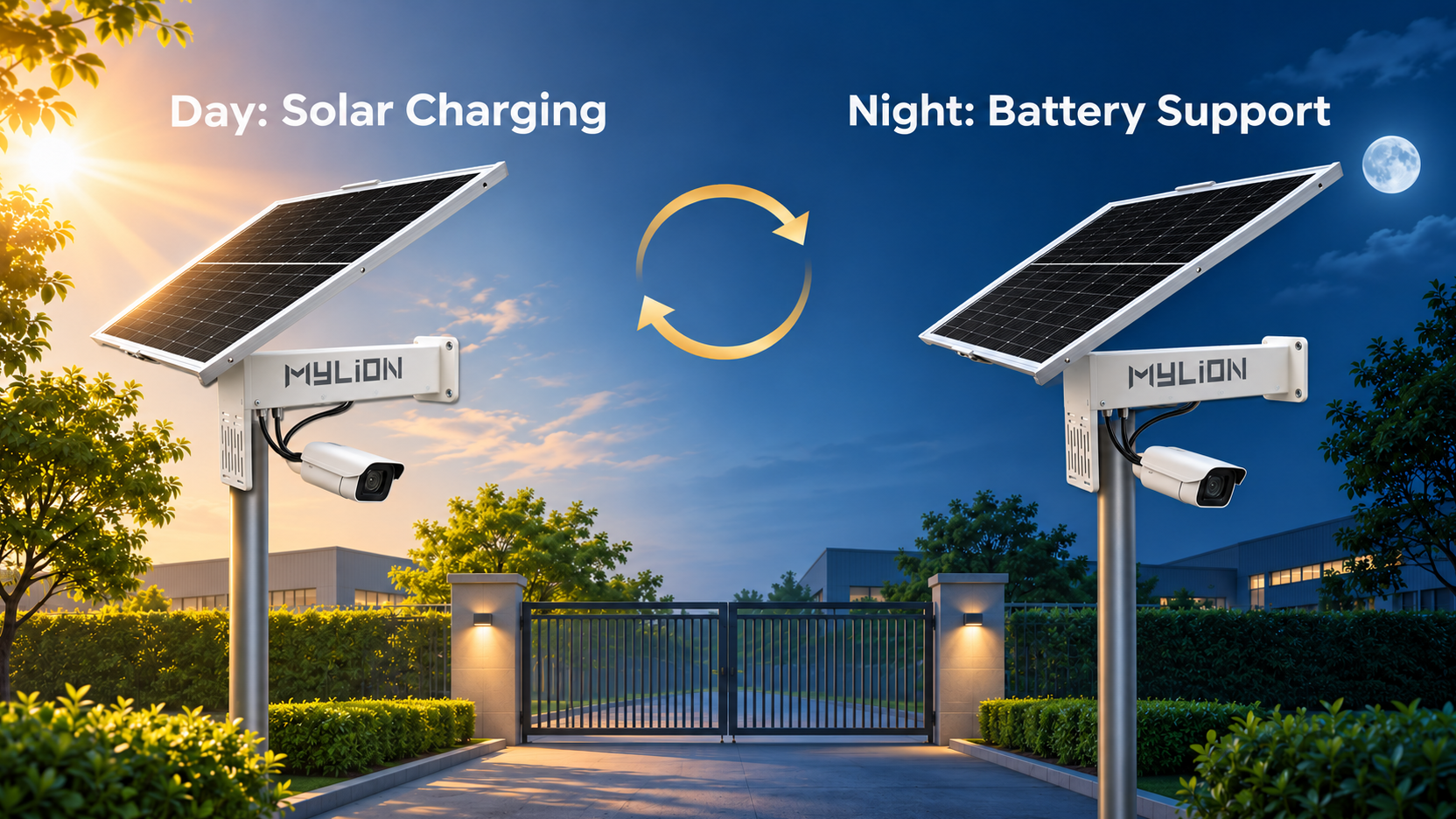
Concept illustration: solar charging replenishes storage in daylight, and stored energy supports operation after dark. It is not a runtime test.
Key MYLION Solar Power Kit Features for B2B Projects
Solar Charging at the Point of Use
MYLION Solar DC UPS Kit models combine a solar panel with battery backup for compatible outdoor devices. The panel provides charging energy where the surveillance equipment is installed, making the solution relevant to locations with limited access to mains electricity.
For buyers planning several monitoring points, a kit gives each location a power configuration to assess against its own sunlight and equipment requirements. Panel placement should provide good exposure to sunlight with as little shading as possible.
LiFePO4 Battery Storage for Power Beyond Daylight
MYLION Solar DC UPS Kit uses lithium iron phosphate, or LiFePO4, battery storage. The battery holds energy from solar charging and supplies the connected equipment when solar generation is unavailable or too low.
This is the feature that supports monitoring after sunset. Storage capacity can also be considered for periods of poor weather. Buyers should define the reserve they need, so MYLION can evaluate a configuration for the intended operating schedule.
Integrated MPPT Charging Management
The published MYLION model specifications include an MPPT charge controller. MPPT stands for maximum power point tracking: it manages the panel’s operating point as part of the solar charging process.
For a project buyer, this means charging management is included in the kit configuration. The buyer can focus the initial discussion on the camera setup, location and required backup, while MYLION reviews the matching power arrangement.
A Packaged Assembly with Installation Components
MYLION’s listed kits include the solar panel, Mini UPS, bracket, and input/output cables. Bringing these components together can reduce the number of separate power items an integrator needs to specify at the start of a project.
The Solar DC UPS Kit is equipped with waterproof DC connectors. Buyers should confirm the required enclosure protection, cable lengths, mounting arrangement and final supply scope for their installation. The camera, router and any additional networking equipment should be identified separately in the project requirements.
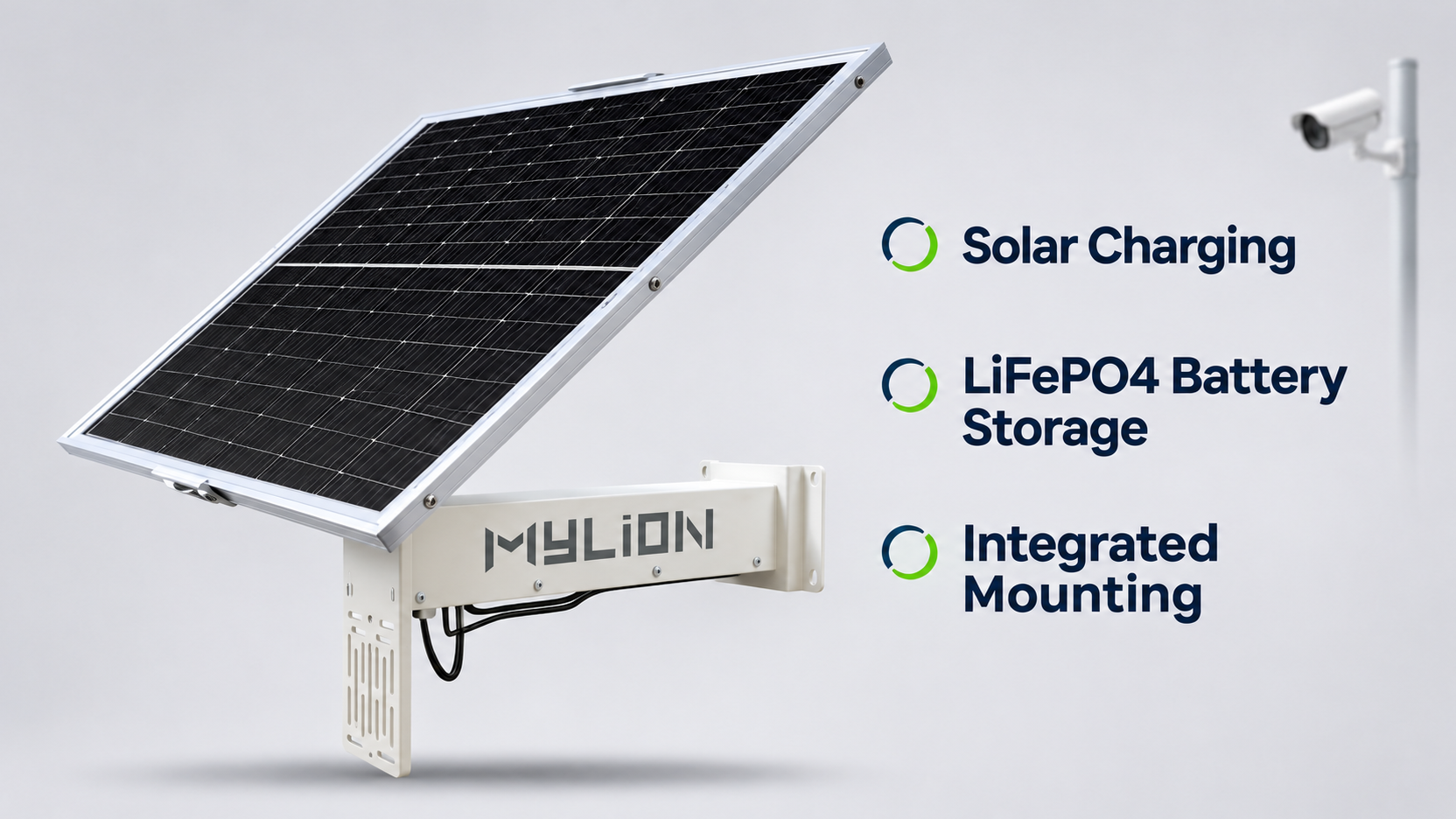
Product-based illustration of the MUL268S form factor. The kit brings solar charging, battery storage and installation components together; the final supply scope is confirmed per project.
Power for Nights and Cloudy Days, Explained Simply
At night, the battery becomes the energy source for the connected CCTV equipment. On cloudy days, stored energy can help cover the gap between the equipment’s demand and the available solar generation.
How long that support lasts depends on the load, usable battery capacity and site conditions. A single low-power camera has a different requirement from a camera with a separate router, infrared illuminator or other accessories. Camera manufacturers such as Axis explain how infrared illumination and heaters can affect power consumption.
For ongoing supply, the panel also needs enough available sunlight to replace the energy used and rebuild the battery reserve after poor weather. A larger battery alone cannot compensate for a continuing shortage of solar charging.
Buyers can keep the discussion simple by providing the equipment models, installation location and required backup period. These details help MYLION assess the complete power requirement without asking the buyer to develop a detailed electrical design first.
Where Is a Solar Power Kit for CCTV Useful?
Farm Entrances and Rural Properties
Cameras at field entrances, livestock areas and isolated gates may be far from convenient power outlets. A solar power kit can be evaluated as a local supply for compatible equipment, with battery reserve planned around overnight monitoring and seasonal sunlight.
Construction Sites and Temporary Monitoring Points
Surveillance may be needed before permanent power is ready, or at a boundary away from site facilities. A packaged solar power solution gives contractors and security integrators an option to review alongside camera coverage, mounting and communications.
Remote Infrastructure and Outdoor Storage Areas
Water facilities, access roads and outdoor equipment yards may need monitoring at dispersed locations. A solar CCTV kit can support a suitable remote power arrangement. The complete site load should include any router or wireless link needed to transmit the video.
Explore MYLION Solar Power Kit Options
MYLION Solar Power Kit range includes configurations for outdoor security, networking and remote low-power applications. The range brings solar charging, LiFePO4 storage, controller matching and connection support into a project-based supply discussion.
The model choice should follow the surveillance requirement. MYLION can review the camera and any connected devices, then discuss whether a listed configuration or a project-specific adjustment is appropriate. Output voltage, connectors and any PoE equipment must be confirmed for the actual setup.
What Should Buyers Share with MYLION?
A useful first enquiry can be brief. Send these five details:
-
-
- Equipment: camera model, quantity and any router or other connected device.
-
- Power requirements: operating voltage and power consumption, or the equipment datasheets.
-
- Operating schedule: continuous monitoring or specific working hours.
-
- Installation conditions: country or city, mounting location and desired backup period.
-
- Procurement needs: estimated quantity, cable or connector requests, and any branding requirements.
A photo of the intended installation can also help clarify mounting space and possible shading. Before bulk procurement, evaluate a sample with the actual equipment, including night operation. Plan access for panel cleaning and checks of the mounting, connections and battery condition.
For a broader technical selection checklist, read our Solar DC UPS Kit selection guide for CCTV and remote monitoring.
Frequently Asked Questions
Can a solar power kit provide continuous power for CCTV?
Yes, a correctly matched system can support continuous operation through a repeating cycle of solar charging and battery use. The available solar energy and battery reserve must cover the complete equipment load and the planned periods without sufficient sunlight.
Does the CCTV camera keep receiving power after sunset?
The battery supplies stored energy after sunset. The required overnight runtime should be checked with the actual camera settings and any additional equipment connected to the same kit.
How many cloudy days can a solar CCTV kit support?
There is no single answer for every kit and camera. Backup duration depends on the selected battery, equipment consumption and available solar input. Share the required reserve with MYLION for project evaluation.
Can the kit power a camera and a router together?
This can be evaluated when the combined load and connection requirements match the selected configuration. Provide both device models so the supply can be reviewed as a complete setup.
Discuss Your CCTV Solar Power Project with MYLION
A Solar Power Kit for CCTV gives B2B buyers a practical way to bring solar charging, battery storage and installation components into one power solution. With the right configuration and suitable site conditions, it can support an ongoing supply for remote monitoring through daylight, overnight operation and planned periods of limited sunlight.
Send Your CCTV Power Requirements to MYLION. Share your equipment, location, backup requirement and estimated quantity to begin a Solar Power Kit evaluation.
 Español
 English
 Deutsch
 Français
 Italiano